

Professional Tire Repair
in Winston-Salem, NC
A flat tire can disrupt your day, but it does not have to sideline you for long. Here in Winston-Salem, NC, getting reliable and prompt tire repair service is essential for every driver. Your tires are the only part of your vehicle that makes direct contact with the road, making their condition critical for your safety, fuel efficiency, and overall driving performance. Whether you have picked up a nail on I-40, noticed a slow leak, or are concerned about uneven tread wear, our expert technicians are here to help. We provide thorough inspections to determine if a repair is a safe and viable option. Our goal is to get you back on the road safely and efficiently, with service you can trust. By addressing tire issues early, you can avoid more significant problems and extend the life of your tires, saving you time and money. Visit our dedicated used car service center in Winston-Salem, NC for all your automotive needs.
Rely on our skilled team for all your tire service needs. We handle more than just simple puncture repairs; we offer a full spectrum of tire maintenance to keep your vehicle performing at its best. From precise patching and plugging to expert tire rotation and balancing, we use quality techniques and equipment. Our commitment is to provide dependable solutions that prioritize your safety on the roads of the Piedmont Triad. You can easily schedule service online to fit your busy lifestyle.
Your Comprehensive Guide to Tire Repair and Maintenance
Navigating the roads of Winston-Salem and the surrounding communities of Kernersville, Clemmons, and Lewisville demands that your vehicle be in top condition, and that starts with your tires. Tire damage is a common and frustrating experience for any driver. It can happen unexpectedly from road debris, potholes, or simple wear and tear. Understanding the types of tire damage, the repair process, and when replacement is necessary is key to maintaining your vehicle’s safety and integrity. A simple puncture from a nail or screw is often repairable, but other issues like sidewall damage or large gashes typically require a full replacement to keep you safe.
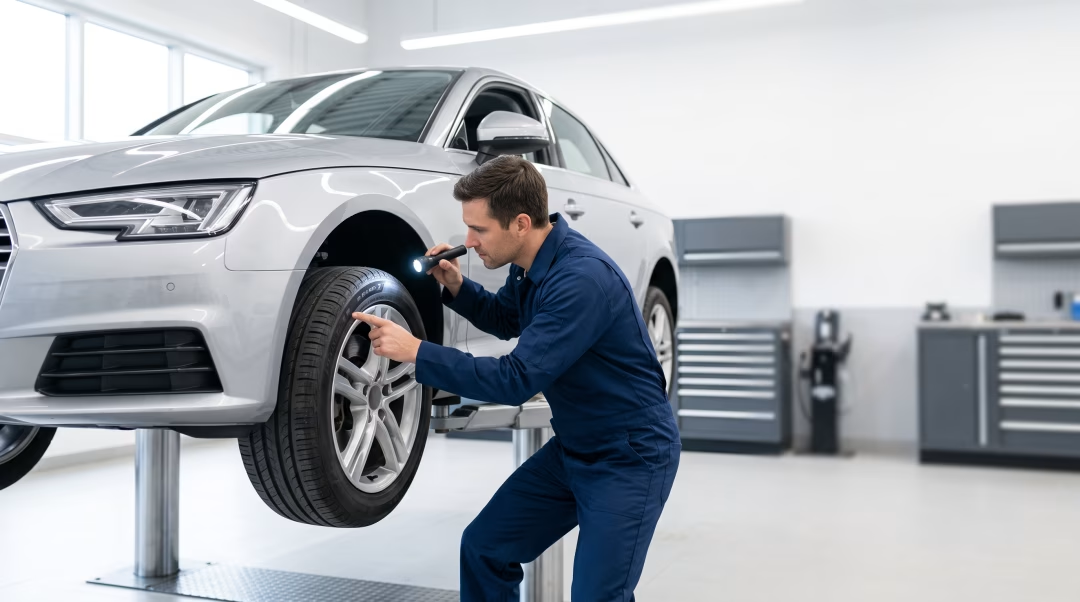
Our skilled technicians begin every tire service with a comprehensive inspection. We dismount the tire from the wheel to examine the interior and exterior surfaces for hidden damage. This crucial step allows us to determine the full extent of the problem and decide on the best course of action. Ignoring a tire issue, even a seemingly minor one, can lead to a dangerous blowout, loss of control, and potential damage to other vehicle components like your wheels and suspension. Regular tire maintenance is a small investment that pays significant dividends in safety and peace of mind.
Identifying Common Tire Problems
Drivers face a variety of tire issues. The most frequent is a puncture in the tread area, usually caused by sharp objects like nails, screws, or glass. These can often be safely repaired if the puncture is less than a quarter-inch in diameter and is not located on the shoulder or sidewall of the tire. Another common problem is a slow leak, which can be caused by a small puncture, a faulty valve stem, or corrosion on the wheel where the tire bead seals. Slow leaks are particularly deceptive because they reduce tire pressure gradually, affecting handling and fuel economy before becoming a flat.
Sidewall damage, including cuts, bulges, or bubbles, is a much more serious issue. The sidewall is not reinforced in the same way as the tread and is under constant flexing pressure. Any compromise to its structural integrity means the tire cannot be safely repaired and must be replaced immediately. Similarly, tires with extensive tread wear, cracks in the rubber, or multiple previous punctures in close proximity are also candidates for replacement rather than repair. Our team can help you assess the condition of your tires and provide clear, honest advice. For a complete vehicle check-up, consider our preventive car maintenance services.
The Professional Tire Repair Process
A proper tire repair is more involved than simply plugging a hole from the outside. The industry standard, and the method we follow, involves a patch-plug combination for the most durable and reliable seal. The process begins with locating the puncture and then carefully inspecting the entire tire. Next, the technician will prepare the inner liner of the tire by cleaning and buffing the area around the puncture to create a suitable surface for the patch to adhere to. The puncture channel is then reamed to the correct size and a vulcanizing rubber stem is pulled through from the inside out. Finally, a special patch is applied to the inner liner over the prepared area, and the entire assembly is sealed with an inner liner sealant. This multi-step process creates a permanent, airtight seal that restores the tire's integrity. After the repair, the tire is remounted, inflated to the correct pressure, and balanced to prevent vibrations. A proper balance is essential for a smooth ride and is a standard part of our quality service.
When to Repair vs. When to Replace Your Tires
Knowing whether to repair or replace a damaged tire is a critical safety decision. As a general rule, a tire can be repaired if the puncture is in the tread area and is no larger than 1/4 inch in diameter. However, there are several situations where replacement is the only safe option:
- Punctures in the sidewall or shoulder area of the tire.
- Large punctures or gashes greater than 1/4 inch.
- Tires that have been driven on while flat, which can cause internal structural damage.
- Visible bulges, bubbles, or deep cuts on the sidewall.
- Excessive or uneven tread wear (less than 2/32 of an inch remaining).
- Multiple punctures that are too close together.
If your tire falls into any of these categories, our team will recommend a suitable replacement from our selection of quality tires. We can help you find a new tire that matches your vehicle's specifications and your other existing tires. If you are in the market for a different vehicle, browse our extensive used inventory to find the perfect car, truck, or SUV.
Tire Pressure Monitoring System (TPMS) Service
Modern vehicles are equipped with a Tire Pressure Monitoring System (TPMS) that alerts you when one or more of your tires are significantly under-inflated. If your TPMS light comes on, it is a crucial warning sign that you should not ignore. Our technicians are equipped to handle all aspects of TPMS service. We can diagnose the cause of the alert, whether it is a simple puncture or a malfunctioning sensor, and perform the necessary repairs. We can also reset the system after a tire repair, rotation, or replacement to make sure it is functioning correctly and providing you with accurate readings. Maintaining a properly working TPMS is essential for safety, optimizing fuel efficiency, and maximizing tire life.
Frequently Asked Questions About Tire Repair
Is it safe to drive on a repaired tire?
Yes, when a tire is repaired properly using the industry-standard patch-plug combination method, it is considered a permanent and safe solution. The repair restores the tire's airtight seal and structural integrity, allowing you to drive on it with confidence for the remainder of its tread life.
How long does a typical tire repair take?
A professional tire repair, which includes dismounting, inspecting, patching, remounting, and balancing, typically takes about 30 to 45 minutes. We strive to provide efficient service to get you back on your way as quickly as possible. You can always contact us for current wait times.
Can a tire with a nail in the sidewall be repaired?
No, punctures or any form of damage to the tire's sidewall cannot be safely repaired. The sidewall experiences high levels of stress and flex while driving, and a repair in this area would not be reliable. A tire with sidewall damage must always be replaced to maintain vehicle safety.
What is the difference between a plug and a patch?
A plug is a rubber strip that is inserted into the puncture from the outside of the tire. A patch is applied to the inner liner of the tire. The safest and most effective method, which we use, is a combination patch-plug that seals the puncture from the inside out, providing a comprehensive and permanent repair.
Why did my TPMS light stay on after a tire repair?
After a tire is repaired and reinflated, the TPMS system may need to be manually reset to recognize the correct pressure. In some cases, the light could also indicate an issue with the sensor itself or a problem with another tire on the vehicle. Our technicians will make sure the system is reset and functioning correctly after any tire service.
